7 Mock JIPMAT
Quantitative Ability
The sum of the first 50 odd natural numbers is:
The sum of the digits of \(\operatorname{LCM}(12,\,18,\,24)\) is:
The unit digit of \(13^{45}\) is:
A number is first increased by 25% and the resulting value is then decreased by 20%. The net percentage change in the original number is:
If 30% of A equals 18% of B, then A : B is:
A shopkeeper marks an article 40% above cost and offers a 25% discount on the marked price. His profit/loss percentage is:
After two successive discounts of 10% and 20% on a marked price of ₹1,000, the selling price is:
The simple interest on ₹4,500 at 8% per annum for 3 years is:
A sum amounts to ₹2,420 in 2 years and ₹2,662 in 3 years under compound interest, compounded annually. The rate of interest per annum is:
A, B and C invest ₹4,000, ₹6,000 and ₹10,000 respectively in a business. If the annual profit is ₹6,000, C’s share is:
A 60-litre mixture contains milk and water in the ratio 3 : 1. To make the ratio 1 : 1, the litres of water that must be added is:
The average age of a group of 25 students is 16 years. When the teacher’s age is included, the average rises to 17 years. The teacher’s age (in years) is:
Two trains, each 150 m long, move in opposite directions on parallel tracks at 54 km/h and 36 km/h respectively. The time (in seconds) they take to cross each other completely is:
A boat covers 24 km downstream in 2 hours and the same distance upstream in 3 hours. The speed of the boat in still water (in km/h) is:
A man walks at 5 km/h and reaches his office 10 minutes late. If he walks at 6 km/h, he reaches 5 minutes early. The distance to his office (in km) is:
Pipe A fills a tank in 12 hours and pipe B fills it in 18 hours. If both are opened together, the time (in hours) to fill the tank is:
A and B together can do a piece of work in 10 days. A alone can do it in 15 days. The number of days in which B alone can complete it is:
The number of ways in which the letters of the word NUMBER can be arranged so that the vowels always come together is:
A committee of 3 is to be chosen from 5 men and 4 women such that it contains at least one woman. The number of such committees is:
A card is drawn at random from a standard pack of 52 playing cards. The probability that it is a face card (J, Q or K) is:
A fair coin is tossed three times. The probability of getting exactly two heads is:
In a class of 60 students, 35 like cricket, 30 like football and 10 like neither. The number of students who like both cricket and football is:
The area (in cm²) of a circle whose circumference is 44 cm is (take \(\pi=22/7\)):
The diagonal of a square is \(8\sqrt{2}\) cm. Its area (in cm²) is:
If \(x+\dfrac{1}{x}=3\), then \(x^{2}+\dfrac{1}{x^{2}}\) equals:
The roots of the equation \(x^{2}-5x+6=0\) are:
The 12th term of the arithmetic progression \(5,\;9,\;13,\;17,\;\ldots\) is:
The value of \(\log_{2}(64) + \log_{3}(81)\) is:
If \(\sqrt{x+9}=x-3\), then the value of \(x\) is:
The smallest 4-digit number exactly divisible by 12, 15 and 20 is:
In a right-angled triangle, the lengths of the two legs are 9 cm and 12 cm. The length of the hypotenuse (in cm) is:
Three years ago, a father was four times as old as his son. After three years, the father will be three times as old as the son. The son’s present age (in years) is:
A shopkeeper sells two articles for ₹990 each. On one he gains 10% and on the other he loses 10%. His overall result on the two transactions is:
Data Interpretation & Logical Reasoning
Instructions [34-37]:
The bar chart below shows the quarterly revenue (in ₹ lakhs) of four branches — A, B, C and D — across the first three quarters of a financial year. Use the chart to answer the questions that follow.
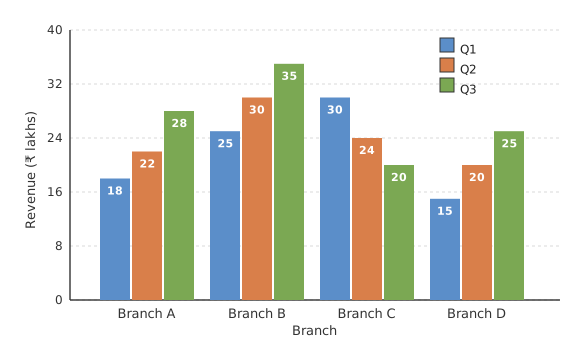
The combined revenue (in ₹ lakhs) of all four branches in Q2 is:
The branch with the highest total revenue across the three quarters is:
The branch with the highest percentage growth in revenue from Q1 to Q3 is:
The difference (in ₹ lakhs) between the highest and the lowest Q3 revenue among the four branches is:
Instructions [38-41]:
The pie chart below shows how a company’s monthly expense budget of ₹3,60,000 is split across six heads. Use the chart to answer the questions that follow.
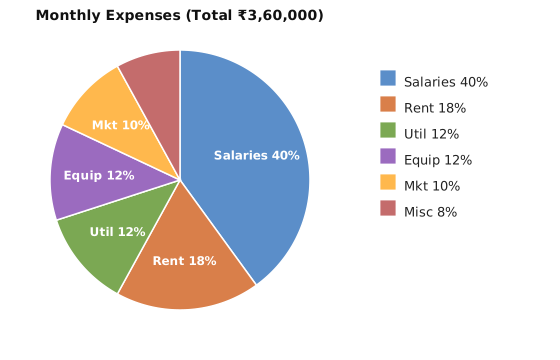
The monthly amount spent on Salaries is:
The difference (in degrees) between the central angles of the Salaries and Marketing slices is:
The combined monthly amount spent on Equipment, Marketing and Misc heads is:
If next month the Rent doubles in rupee terms while every other head stays the same, the new total monthly expenses will be:
A is the mother of B. C is the sister of B. D is the son of C. How is A related to D?
P is the brother of Q. R is the mother of P. S is the sister of R. How is S related to Q?
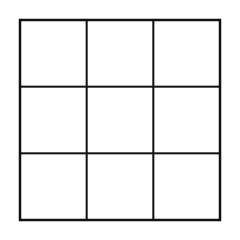
Look at the figure below. The total number of squares (of every size) that can be counted is:
The next term in the series \(2,\;6,\;12,\;20,\;30,\;\ldots\) is:
The next letter in the series A, C, F, J, O, ? is:
A man walks 5 m North, then 12 m East, then 5 m South. His distance from the starting point (in metres) is:
If in a certain code “BOOK” is written as “DQQM”, then “READ” is written as:
In a row of 40 students, A is 15th from the left end and B is 21st from the right end. The number of students sitting between A and B is:
Statements: All cats are dogs. All dogs are mammals.
Conclusions:
I. All cats are mammals.
- Some mammals are cats.
Which of the following follows?
If “PEN” is coded as “RGP” and “INK” is coded as “KPM”, then “PIN” is coded as:
A number puzzle:
\(5 + 3 = 28\)
\(9 + 1 = 810\)
\(8 + 6 = 214\)
Then \(5 + 4 = ?\)
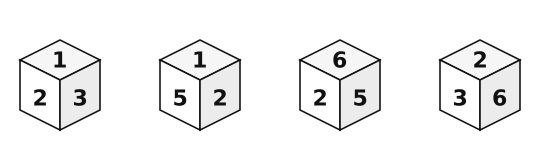
Four views of a single standard die are shown below. The number on the face opposite to the face marked 3 is:
The mirror image of the number 1235 when the mirror is placed to its right (vertical mirror) is:
The mirror image (vertical mirror placed on the right) of the figure on the left is:

The water image (horizontal mirror placed below) of the word HORIZON is best described as:
The water image of the figure on the left (horizontal mirror placed at its bottom edge) is:

Bird is to Sky as Fish is to:
Choose the odd one out:
Six friends — P, Q, R, S, T and U — sit in a row facing north. P is at the left end. U sits to the immediate right of P. R sits to the immediate right of U. S sits between R and T. Q sits at the right end. Who sits between S and Q?
Among five children A, B, C, D and E, A is taller than B but shorter than C. D is taller than C. E is the shortest. The tallest among them is:
A clock shows 9:30. The angle between the hour and the minute hand (in degrees) is:
The minimum number of straight lines required to form two squares is:
A cube is painted on all six faces and then cut into 27 equal smaller cubes. The number of smaller cubes with exactly two painted faces is:
In a queue of 30 people, Rahul is 12th from the front. Priya is 5 places behind Rahul. Priya’s position from the back of the queue is:
A boy is facing North. He turns 90° clockwise, then 180° anti-clockwise, then 45° clockwise. The direction he is now facing is:
Verbal Ability & Reading Comprehension
Read the passage below and answer questions 67–71:
When Johannes Gutenberg combined movable metal type with the screw press in the mid-fifteenth century, few in Mainz could have foreseen what was beginning. Within fifty years, presses had spread across Europe, and the cost of a book — once the work of monastic scribes over months — collapsed to a fraction of its earlier price. Vernacular languages, hitherto regarded as inferior to Latin, were lifted by the new medium: the Bible was printed in German, then in English and French, and ordinary readers encountered texts that had been the preserve of clerics. The act of reading itself became more private, since affordable books could be owned and consulted alone. Scholarship grew faster because researchers in different cities could compare identical pages and cite the same line numbers — a small change with large consequences for collaboration. Yet the press also amplified existing tensions. Pamphlets attacking the Catholic Church reached audiences far larger than any preacher could address, and the Reformation spread along the same trade routes that carried Gutenberg’s type. Censorship offices proliferated in response. Looking back, what is striking is not that the printing press changed everything at once, but that for a century it changed almost everything in stages — slowly, unevenly and with consequences its inventor would not have recognised.
According to the passage, the most direct effect of the printing press on book prices was that they:
The passage suggests that vernacular languages were:
Which of the following is given in the passage as a way printing helped scholarship?
The passage attributes the rapid spread of the Reformation primarily to:
The author’s overall stance on the printing press is best described as:
Identify the part of each sentence (67–71 onward, items 72–77) that contains an error. If there is no error, choose option 4.
Each of the students (A)/ have submitted their assignment (B)/ before the deadline. (C)/ No error (D)
The committee, along with its chairperson, (A)/ are scheduled to attend (B)/ the inauguration tomorrow. (C)/ No error (D)
Neither the manager nor the employees (A)/ was aware (B)/ of the new policy. (C)/ No error (D)
She is one of those people (A)/ who always helps (B)/ those in need. (C)/ No error (D)
Although he was tired, (A)/ but he completed (B)/ the assignment on time. (C)/ No error (D)
The number of applicants (A)/ have increased significantly (B)/ this year. (C)/ No error (D)
Fill in the blank with the most appropriate option (Q78–Q81):
She is well known _____ her contributions to medical research.
He has been working here _____ 2018.
The book is divided _____ five chapters.
Pick the homophone of the word steal (to take wrongfully):
Choose the word that best matches each definition (Q82–Q86):
A person who knows many languages is called a:
A government by the few is called:
A speech delivered without preparation is:
Choose the word closest in meaning to benevolent:
The idiom “to let the cat out of the bag” means:
Rearrange the four sentences P, Q, R, S in the correct order (Q87–Q89):
Rearrange:
P. Today, India is the world’s third-largest startup ecosystem, with strong activity in fintech, edtech and software-as-a-service.
Q. The Indian startup landscape was, until the early 2000s, a relatively small space dominated by family businesses and a handful of IT services firms.
R. Easier access to early-stage capital and a maturing pool of mentors turned isolated successes into a steady deal flow.
S. A wave of e-commerce companies in the late 2000s changed the perception that Indian founders could build only services businesses.
Rearrange:
P. Yet the impact on energy consumption has been mixed, with data centres now rivalling several mid-sized countries in electricity use.
Q. The shift to cloud computing began as a way for companies to lower the cost of running their own servers.
R. Today, almost every major application — from streaming to banking — lives in a public or hybrid cloud.
S. As infrastructure became more reliable, even regulated industries like healthcare and finance moved sensitive workloads to the cloud.
Rearrange:
P. Vaccines remain one of the most cost-effective public-health interventions ever invented.
Q. Yet hesitancy and misinformation have begun to erode trust in routine immunisation programmes.
R. Coverage gains during the late twentieth century pushed several childhood diseases to the brink of elimination.
S. Restoring confidence will require clearer communication, not just better vaccines.
Read the passage below and answer questions 90–95:
The global shift to renewable energy is sometimes described as a single transition, but in practice it is several different races running in parallel. Solar photovoltaics, whose costs have fallen by more than ninety per cent since 2010, are now the cheapest source of new electricity generation in most parts of the world. Onshore wind, slower to scale up in dense regions, is nevertheless the dominant source of new capacity in many developed markets. Offshore wind, despite higher capital costs, has begun to deliver gigawatt-scale projects off the coasts of Europe and Asia. Less visible than the generation side is the parallel race in storage and grid management, where lithium-ion batteries, pumped hydro and emerging long-duration technologies must work together to absorb intermittent supply. Critics argue that the transition is not fast enough to limit warming to safer thresholds, and that subsidies and grid permits still favour incumbent fossil generation. Defenders respond that record-setting deployments and falling unit costs prove the direction of travel, even if the pace is uneven. What both sides increasingly accept is that the decisive battles will not be fought over the wind or sun resource itself — both are abundant — but over the wires, batteries and policies that decide whether that abundance reaches the consumer.
According to the passage, the cost of solar photovoltaics since 2010 has:
The passage describes onshore wind as:
“Less visible than the generation side” in the passage refers to:
The author notes that critics of the transition argue that:
Which of the following best captures the author’s overall view?
The phrase “even if the pace is uneven” suggests that:
Read the passage below and answer questions 96–100:
For most of the twentieth century, the gut was treated as a quiet plumbing system — useful but uninteresting. That picture has changed. We now know that the human digestive tract hosts trillions of micro-organisms, collectively called the gut microbiome, whose total genetic information exceeds our own by orders of magnitude. These microbes help digest food we cannot break down on our own, train the developing immune system, produce vitamins and influence the chemical signals that travel between the gut and the brain. Studies in the last decade have linked an imbalanced microbiome — sometimes called dysbiosis — to a surprisingly wide range of conditions, from inflammatory bowel disease and obesity to anxiety and certain auto-immune disorders. None of this means that the microbiome causes every illness it is associated with; correlation is not causation, and the strongest claims continue to outrun the evidence. What it does mean is that the boundary between “us” and “them” is less clear than it once seemed: we are, in a real sense, walking ecosystems whose health depends on the partners we carry.
According to the passage, the gut microbiome’s total genetic information:
The passage lists each of the following as a contribution of gut microbes EXCEPT:
The term “dysbiosis” in the passage refers to:
The author’s caution that “correlation is not causation” suggests that:
The author’s overall message is that: