5 Mock JIPMAT
Quantitative Ability
The largest three-digit number that is exactly divisible by both 6 and 8 is:
The LCM of 28 and 42 is:
The remainder when \(3^{61}\) is divided by 5 is:
The price of an article is first raised by 10%, then by another 20%, and finally reduced by 25%. The net percentage change in its price is:
A’s salary is 20% more than B’s. By what percent is B’s salary less than A’s?
A merchant sells two items at ₹999 each — gaining 10% on one and losing 10% on the other. His net result is:
A retailer marks his goods 25% above cost and then offers a discount of 10%. His profit percentage is:
The simple interest on ₹6,000 at 8% per annum for 2.5 years is:
At what rate per annum compounded annually will ₹2,000 amount to ₹2,420 in 2 years?
Three numbers are in the ratio \(2 : 3 : 5\) and their sum is 200. The largest of the three numbers is:
A vessel contains 50 litres of pure milk. 10 litres is drawn out and replaced with water; this is repeated once more. The percentage of milk now left in the vessel is:
The mean of five observations is 25. When a new observation is added, the mean becomes 27. The value of the new observation is:
A cricketer’s average in 7 matches is 50 runs. His average in 5 of those matches is 46 runs. His average in the remaining 2 matches is:
The average weight of 8 boys is 50 kg. When a boy weighing 38 kg is replaced by a new boy, the new average rises to 51 kg. The new boy’s weight is:
A man covers a distance in 6 hours at 40 km/h. To cover the same distance in 4 hours he must travel at:
A train passes a pole in 12 seconds and a 200 m platform in 32 seconds. The length of the train (in metres) is:
A boat covers 24 km upstream in 6 hours and returns the same distance in 4 hours. The speed of the boat in still water is:
A is 50% more efficient than B. Working together they finish a piece of work in 24 days. A alone will finish the same work in:
A can finish a piece of work in 20 days and B in 30 days. They work together for 5 days and then A leaves. The number of days B alone takes to finish the remaining work is:
The number of distinct four-digit numbers that can be formed from the digits \(1, 2, 3, 4, 5, 6\) without repetition is:
The number of distinct arrangements of the letters of the word ENGINEERING is:
Two cards are drawn at random from a well-shuffled standard pack of 52. The probability that both are kings is:
A fair die is thrown twice. The probability that the sum of the numbers on the two throws is 7 is:
In a class of 60 students, 35 like Mathematics, 25 like Physics and 15 like both. The number of students who like Mathematics only is:
The sum of the digits of a two-digit number is 11. When the digits are reversed, the number increases by 9. The original number is:
If \(\alpha + \beta = 5\) and \(\alpha\beta = 6\), then \(\alpha^{2} + \beta^{2}\) equals:
The values of \(k\) for which the equation \(x^{2} + kx + 16 = 0\) has equal roots are:
The legs of a right-angled triangle are 6 cm and 8 cm. The length of the hypotenuse is:
The sum of all interior angles of a regular polygon with 10 sides is:
The volume of a right circular cone with radius 7 cm and height 12 cm is (take \(\pi = 22/7\)):
The area of an equilateral triangle whose side measures 12 cm is:
The diagonals of a rhombus are 24 cm and 10 cm. The length of each side of the rhombus is:
The curved surface area of a right circular cylinder with radius 7 cm and height 15 cm is (take \(\pi = 22/7\)):
Data Interpretation & Logical Reasoning
Instructions [34-37]:
The bar chart below shows the production (in thousand tonnes) of four commodities — Wheat, Rice, Maize and Pulses — during Quarter 1 and Quarter 2. Use the chart to answer the questions that follow.
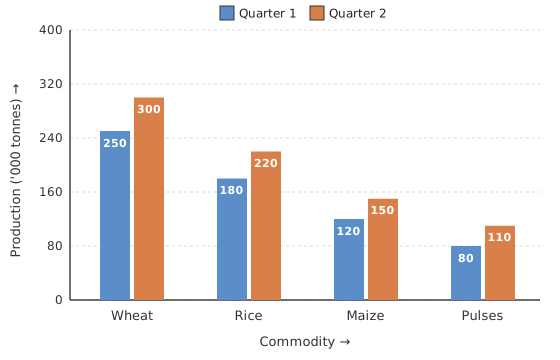
The total production of all four commodities in Q2 (in thousand tonnes) is:
The commodity that recorded the highest percentage growth from Q1 to Q2 is:
The combined production of Wheat over Q1 and Q2 together is:
The average Q1 production across the four commodities (in thousand tonnes) is:
Instructions [38-41]:
The pie chart below shows the distribution of 1,000 employees of a company across six departments. Use the chart to answer the questions that follow.
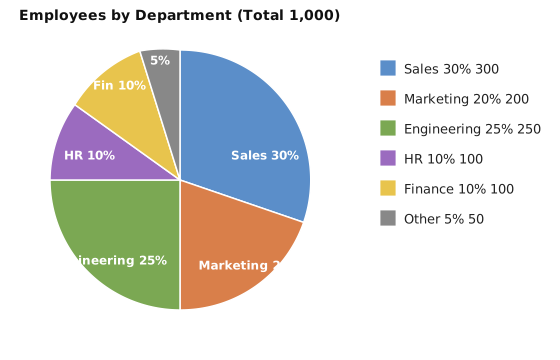
The number of employees in the Engineering department is:
The central angle (in degrees) corresponding to the HR slice is:
The difference between the number of employees in Sales and Marketing is:
If the company expands its Sales team by 10% (other departments unchanged in head count), the new total employee strength becomes:
A is the son of B’s father. C is the brother of B. How is A related to C?
Pointing to a man, Riya said, “He is the husband of my sister.” How is the man related to Riya?
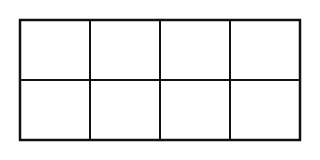
The total number of rectangles (of all sizes) in the figure below is:
A person initially facing north turns 90° to his right, walks 5 m; then turns 90° to his right and walks 5 m; then turns 90° to his right once more and walks 5 m. The direction he is finally facing is:
Statements: All managers are leaders. All leaders
are confident.
Conclusions:
I. All managers are
confident.
II. Some confident people are managers.
Which of the conclusions follow?
Statements: Some students are athletes. All athletes
are tall.
Conclusions:
I. Some students are
tall.
II. Some tall people are athletes.
Which of the conclusions follow?
Statements: No fish is a bird. All eagles are
birds.
Conclusions:
I. No eagle is a fish.
II. Some birds are not fish.
Which of the conclusions follow?
If LIGHT is coded by adding the alphabet positions of its letters \((L+I+G+H+T = 56)\), what is the code for DARK?
In a certain code, FISH is written as GJTI (each letter shifted by \(+1\)). The code for RAIN is:
Find the next term in the series: \(5,\ 11,\ 23,\ 47,\ 95,\ ?\)
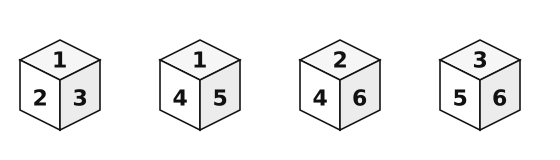
Four different positions of the same die are shown below. The face opposite to 2 is:
Find the next term in the series: \(7,\ 9,\ 13,\ 21,\ 37,\ ?\)
Find the next letter in the series: \(A,\ B,\ D,\ G,\ K,\ ?\)
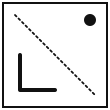
The mirror image of the figure given below is:
Six persons P, Q, R, S, T and U are sitting in a row. Q is at the right end. P is 3rd from the left. R is to the immediate right of P. S is to the immediate left of P. T is to the immediate left of S. The person at the left end is:
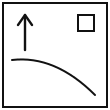
The water image of the figure given below is:
At what time between 2 o’clock and 3 o’clock will the hour hand and the minute hand of a clock be together?
If 1 January 2000 was a Saturday, then 1 January 2001 was a:
The angle between the hour hand and the minute hand of a clock at 3 : 15 is:
Question: What is the speed of a boat in still
water?
Statement I: The boat takes 4 hours to
travel 60 km downstream.
Statement II: The speed of
the stream is 5 km/h.
Question: What is the perimeter of a rectangle?
Statement I: The area of the rectangle is 60 cm².
Statement II: The length of the rectangle is twice its
breadth.
Choose the pair that has a relationship similar to Bird : Sky.
Find the number that fits the analogy: \(5 : 27 :: 8 : ?\)
Find the odd one out: Apple, Banana, Mango, Cucumber
One term in the series below is incorrect. Identify it: \(4,\ 9,\ 16,\ 25,\ 35,\ 49\)
Verbal Ability & Reading Comprehension
Choose the word that is most nearly the synonym of: DILIGENT
Choose the word that is most nearly the synonym of: INDIGENT
Choose the word that is most nearly the synonym of: APATHY
Choose the word that is most nearly the synonym of: SUCCINCT
Choose the word that is most nearly the antonym of: ABUNDANT
Choose the word that is most nearly the antonym of: ELATED
Choose the word that is most nearly the antonym of: ETERNAL
Choose the word that is most nearly the antonym of: ARDENT
Identify the part of the sentence that contains a grammatical error:
- The team / (B) which won the match / (C) were given / (D) a trophy yesterday.
Identify the part of the sentence that contains a grammatical error:
- Neither the doctor / (B) nor his patients / (C) was present / (D) at the conference.
Identify the part of the sentence that contains a grammatical error:
- Each of the students / (B) have submitted / (C) their assignments / (D) on time.
Identify the part of the sentence that contains a grammatical error:
- He is one of / (B) those persons / (C) who is / (D) always polite.
Fill in the blanks with the most appropriate pair of prepositions:
Akbar was a king _________ great wisdom and _________ exceptional generosity.
Choose the most appropriate word for the blank:
He invited me _________ the party.
Choose the one-word substitute for: A person who eats human flesh.
Choose the one-word substitute for: A form of government in which women hold political power.
Choose the one-word substitute for: A doctor who specialises in the eye.
Fill in the blanks with the most appropriate pair of prepositions:
Don’t go _________ that door, it’s locked. We’ll go _________ this one instead.
Choose the meaning of the idiom: “once in a blue moon”
Choose the meaning of the idiom: “to beat around the bush”
Rearrange the following sentences into a logical order:
P. The growth of cities has transformed everyday life in dramatic
ways.
Q. Public transportation, however, has not kept pace with
urban expansion.
R. Hours wasted in commutes now exceed time spent
with family in many households.
S. New job opportunities pull
millions into urban areas every year.
Rearrange the following sentences into a logical order:
P. Today, robotic surgery is performed in hundreds of hospitals.
Q. The first robot-assisted surgery took place in the 1980s.
R.
Initially used only for the most delicate operations, the technology was
costly and rare.
S. As costs fell and surgeons gained training,
adoption widened.
Rearrange the following sentences into a logical order:
P. Yet many believe its influence has only just begun.
Q.
Streaming services have completely reshaped how people consume
entertainment.
R. Major studios are now investing billions in
original streaming content.
S. Traditional broadcast television,
once dominant, struggles to retain viewers.
Instructions [90-95]:
Read the following passage carefully and answer the questions that follow.
The transition to renewable energy is no longer a question of if but how quickly. Once dismissed as too expensive or unreliable, solar and wind power now generate electricity at lower cost per kilowatt-hour than most fossil-fuel sources in many parts of the world. Driving the shift are dramatic declines in panel and turbine prices, improved grid-scale battery storage, and rising public pressure to address climate change. National policies — including tax credits, feed-in tariffs and carbon pricing — have accelerated investment, though unevenly across countries. Critics warn of intermittency: solar produces only by day, wind only when it blows. Yet expanded storage capacity and continent-spanning interconnections increasingly smooth these gaps. A more stubborn challenge is the carbon footprint of manufacturing renewable equipment itself; mining for lithium, cobalt and rare earths raises both environmental and human-rights concerns. The transition is therefore not a technological problem alone but a complex social and economic undertaking that will reshape the global economy for decades to come.
According to the passage, the main driver of the renewable energy transition is:
Critics of renewables, according to the passage, primarily emphasise:
The passage suggests that intermittency challenges are being addressed by:
According to the passage, mining for renewable materials raises:
The phrase “no longer a question of if but how quickly” suggests that:
The author’s overall stance toward the renewable transition is:
Instructions [96-100]:
Read the following passage carefully and answer the questions that follow.
For most of the twentieth century, scientists believed the adult brain was essentially fixed: neural connections formed in childhood, and significant change after maturity was unlikely. That picture has been overturned. Modern neuroscience has shown that the brain remains capable of forming new connections — and even, in limited circumstances, of growing new neurons — throughout life. This property, called neuroplasticity, underlies learning at every age. It explains why stroke patients can recover lost functions, why musicians who practise an instrument develop measurable structural changes in motor cortex, and why people who learn a second language in adulthood show enhanced connectivity in language regions. Neuroplasticity also has implications for mental health: cognitive-behavioural therapy may work in part by literally rewiring distressed neural circuits. The lesson is humbling and hopeful: the brain we end up with at fifty is not the brain we are stuck with — it is the brain shaped by the experiences we have chosen and the practices we have sustained.
According to the passage, the twentieth-century view of the adult brain was that it was:
According to the passage, neuroplasticity:
The example of musicians in the passage demonstrates that:
According to the passage, cognitive-behavioural therapy may work by:
The closing sentence of the passage suggests that the brain at fifty is: