6 Mock JIPMAT
Quantitative Ability
The sum of all even numbers between 1 and 100 (inclusive of 2 and 100) is:
The product of the digits of \(\operatorname{LCM}(15,\,20,\,30)\) is:
The unit’s digit of \(12^{34}\) is:
60 is what percentage more than 50?
If 80% of A equals 50% of B, then the ratio \(A:B\) is:
An item bought at ₹400 is sold at ₹450. The profit percentage is:
The marked price of an article is ₹800 and a 12.5% discount is offered on it. The selling price is:
The simple interest on ₹3,600 at 6% per annum for 3 years is:
A sum amounts to ₹5,500 in 2 years and to ₹6,050 in 3 years at compound interest. The annual rate of interest is:
₹1,200 is divided among A, B and C in the ratio \(3 : 4 : 5\). The largest share is:
A 60-litre mixture contains milk and water in the ratio \(2 : 1\). How much water must be added so that the new ratio becomes \(1 : 1\)?
The mean age of a group of 30 people is 18.5 years. When a new person joins the group the mean rises to 19 years. The new person’s age (in years) is:
A train 200 m long crosses a man walking in the opposite direction at 6 km/h in 12 seconds. The speed of the train is:
A boat covers 12 km upstream in 4 hours and the same distance downstream in 2 hours. The speed of the boat in still water is:
A man runs at 12 km/h on a circular track of length 600 m. The time taken to complete one lap is:
A is twice as efficient as B. Working together they complete a piece of work in 6 days. A alone will complete the same work in:
A and B together can complete \(\dfrac{1}{4}\) of a piece of work in 3 days. The number of additional days needed to finish the remaining work is:
The number of ways in which 5 people can be seated in a row of 8 chairs (one person per chair) is:
The number of distinct arrangements of the letters of the word CHAIRS is:
A card is drawn at random from a standard 52-card deck. The probability that it is a red king is:
Two fair coins are tossed simultaneously. The probability of getting at least one head is:
In a group of 50 people, 30 like cricket, 25 like football and 15 like neither game. The number who like both games is:
If \(2x + 3y = 13\) and \(3x - 2y = 0\), then \(x + y\) equals:
A man’s present age is four times his son’s age. After 16 years his age will be twice his son’s. The son’s present age (in years) is:
The values of \(p\) for which the equation \(x^{2} - px + 36 = 0\) has equal roots are:
If \(\alpha\) and \(\beta\) are the roots of \(2x^{2} - 5x + 3 = 0\), then \(\dfrac{1}{\alpha} + \dfrac{1}{\beta}\) equals:
The circumference of a circle is 44 cm. Its area (taking \(\pi = 22/7\)) is:
In a triangle, two angles are in the ratio \(2 : 3\) and the third angle is 30°. The smallest angle of the triangle is:
The volume of a hemisphere of radius 6 cm is:
The total surface area of a cube of side 10 cm is:
The perimeter of a right-angled triangle whose legs measure 5 cm and 12 cm is:
The area of a trapezium whose parallel sides are 16 cm and 24 cm and whose height is 10 cm is:
A solid cube of side 12 cm is cut into smaller cubes each of side 3 cm. The number of smaller cubes formed is:
Data Interpretation & Logical Reasoning
Instructions [34-37]:
The bar chart below shows the number of vehicles sold (in hundreds) by four dealerships — A, B, C and D — in April, May and June. Use the chart to answer the questions that follow.
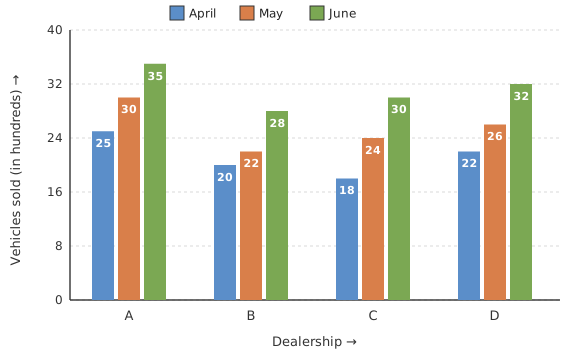
The total number of vehicles sold (in hundreds) by all four dealerships in May is:
The dealership with the highest combined sales across all three months is:
The dealership with the highest percentage growth in sales from April to June is:
The difference between the highest and the lowest June sales among the four dealerships (in hundreds) is:
Instructions [38-41]:
The pie chart below shows how a company’s monthly expenses of ₹2,40,000 are distributed across six heads. Use the chart to answer the questions that follow.
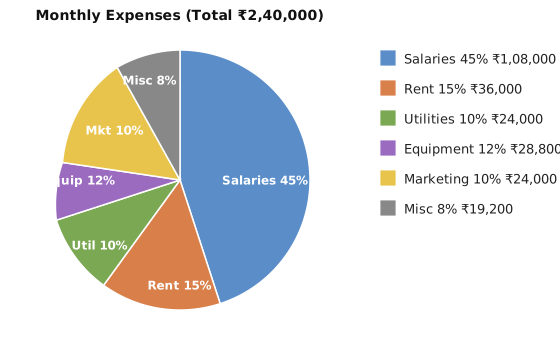
The monthly amount spent on Salaries is:
The difference (in degrees) between the central angles of the Salaries and Rent slices is:
The combined monthly amount spent on Equipment, Marketing and Miscellaneous heads is:
If next month spending on Salaries doubles while every other head remains unchanged in rupee terms, the new total monthly expenses will be:
A is the mother of B. C is the brother of B. D is the daughter of C. How is A related to D?
Pointing to a photograph, Suresh said, “He is the son of my father’s only brother.” How is the person in the photograph related to Suresh?
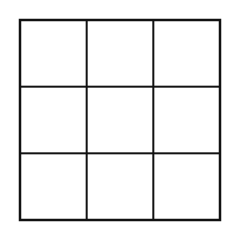
The total number of rectangles (of all sizes) in the figure below is:
A person initially facing south turns 45° clockwise, then turns 45° clockwise again. The direction he is finally facing is:
Statements: All birds are animals. All eagles are
birds.
Conclusions:
I. All eagles are
animals.
II. Some animals are eagles.
Which of the conclusions follow?
Statements: Some doctors are wealthy. All wealthy
people are happy.
Conclusions:
I. Some doctors
are happy.
II. All happy people are doctors.
Which of the conclusions follow?
Statements: No man is immortal. All gods are
immortal.
Conclusions:
I. No man is a god.
II. Some immortal beings are men.
Which of the conclusions follow?
The word MONK is coded by adding the alphabet positions of its letters \((M+O+N+K = 53)\). The code for SAGE is:
In a code, APPLE is written as BQQMF (each letter shifted by \(+1\)). The code for MANGO is:
Find the next term in the series: \(6,\ 18,\ 54,\ 162,\ ?\)
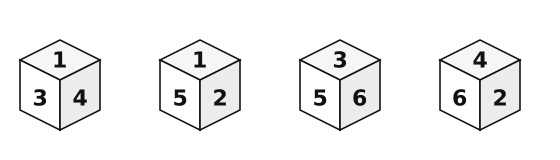
Four different positions of the same die are shown below. The face opposite to 3 is:
Find the next term in the series: \(100,\ 50,\ 25,\ 12.5,\ ?\)
Find the next letter in the series: \(A,\ C,\ F,\ J,\ O,\ ?\)
The mirror image of the figure given below is:

Five friends — A, B, C, D and E — sit in a row. A is at one end. B is in the middle (position 3). C is immediately to the right of A. D is immediately to the right of B. The position of E from the right end is:
The water image of the figure given below is:

At what time between 7 o’clock and 8 o’clock will the hour hand and the minute hand of a clock be at a right angle for the first time?
If 26 January 2020 was a Sunday, what day of the week was 15 August 2020?
The angle between the hour hand and the minute hand of a clock at 8 : 40 is:
Question: What is P’s present age?
Statement I: P is 4 years older than Q.
Statement II: P is 5 years younger than R.
Question: What is the cost of one apple?
Statement I: 6 apples and 4 oranges together cost
₹100.
Statement II: One orange costs ₹10.
Choose the pair that has a relationship similar to Carpenter : Wood.
Find the number that fits the analogy: \(7 : 50 :: 9 : ?\)
Find the odd one out: Lion, Tiger, Leopard, Camel
One term in the series below is incorrect. Identify it: \(1,\ 4,\ 9,\ 16,\ 25,\ 30,\ 49\)
Verbal Ability & Reading Comprehension
Choose the word that is most nearly the synonym of: ALACRITY
Choose the word that is most nearly the synonym of: DELETERIOUS
Choose the word that is most nearly the synonym of: GREGARIOUS
Choose the word that is most nearly the synonym of: PRAGMATIC
Choose the word that is most nearly the antonym of: PROFUSE
Choose the word that is most nearly the antonym of: HAUGHTY
Choose the word that is most nearly the antonym of: VERBOSE
Choose the word that is most nearly the antonym of: TRANQUIL
Identify the part of the sentence that contains a grammatical error:
- Despite of having / (B) a lot of work, / (C) she went / (D) to the party.
Identify the part of the sentence that contains a grammatical error:
- The new range of products / (B) launched by the company / (C) have been / (D) very successful.
Identify the part of the sentence that contains a grammatical error:
- He has been working / (B) in this company / (C) since 12 years / (D) without any break.
Identify the part of the sentence that contains a grammatical error:
- She is one of / (B) the brightest students / (C) who has / (D) ever come to this school.
Fill in the blanks with the most appropriate pair of prepositions:
He arrived _________ India _________ Tuesday morning.
Choose the most appropriate word for the blank:
Please _________ to my advice and don’t act rashly.
Choose the one-word substitute for: The study of ancient societies through their material remains.
Choose the one-word substitute for: One who hates all human beings.
Choose the one-word substitute for: A medicine that kills bacteria or stops their growth.
Fill in the blanks with the most appropriate pair of prepositions:
He is afraid _________ heights but excited _________ travelling.
Choose the meaning of the idiom: “to bite off more than you can chew”
Choose the meaning of the idiom: “a piece of cake”
Rearrange the following sentences into a logical order:
P. Today, the demand for English-language teachers worldwide remains
strong.
Q. English has been the dominant international language of
business and science for decades.
R. As emerging economies grow, the
appetite for English education only increases.
S. Universities in
Europe, Asia and Latin America now offer entire degree programs in
English.
Rearrange the following sentences into a logical order:
P. The result is a remarkable expansion of credit access.
Q.
Microfinance institutions originally served poor borrowers who lacked
bank accounts.
R. Today these institutions also serve small
businesses and the underbanked.
S. Mobile banking technology has
dramatically reduced the cost of reaching new customers.
Rearrange the following sentences into a logical order:
P. Yet vaccine hesitancy has slowed progress in some communities.
Q. Vaccines have been one of the greatest public-health interventions in
history.
R. Diseases like polio and measles, once endemic, now occur
only rarely.
S. Persistent education and outreach remain essential
to maintaining coverage.
Instructions [90-95]:
Read the following passage carefully and answer the questions that follow.
Artificial intelligence has moved from research labs into everyday products faster than its risks can be assessed. Critics worry about three categories of harm: discriminatory bias embedded in training data, opaque decision-making that resists scrutiny, and a concentration of power in the few companies that can afford to train the largest models. Proposed regulatory responses range from mandatory audits of high-stakes systems to outright bans on specific applications such as social scoring or large-scale facial recognition. The European Union’s AI Act, the world’s first comprehensive AI law, takes a risk-based approach, applying tighter rules to applications that could threaten safety or fundamental rights. Critics of regulation argue that overly stringent rules may slow innovation and push development to jurisdictions with weaker oversight. Defenders counter that early standards build trust and create level playing fields. Whatever the merits, the regulatory debate is no longer theoretical: governments worldwide are now drafting rules that will shape what AI products look like for years to come.
According to the passage, AI has moved into everyday products:
The three categories of harm mentioned by critics in the passage are:
The European Union’s AI Act, according to the passage, takes:
Critics of strict AI regulation, according to the passage, argue that it may:
Defenders of regulation, according to the passage, argue that early standards:
The author’s overall view of the AI regulatory debate is best described as:
Instructions [96-100]:
Read the following passage carefully and answer the questions that follow.
Beneath the floor of every healthy forest lies an invisible network of unimaginable complexity. Tree roots are entwined with the microscopic threads of fungi in partnerships called mycorrhizal associations. The fungi extract minerals from the soil and pass them to the trees; in return the trees provide the fungi with sugars produced by photosynthesis. Recent research has shown that this network does far more than nourish individual trees: it also allows trees to communicate. When one tree is attacked by an insect, it releases chemical signals that travel through the mycorrhizal network to neighbours, prompting them to produce defensive chemicals. Older “mother trees” appear to recognise their own seedlings and channel extra nutrients to them. The picture that emerges is of a forest functioning less like a collection of individuals and more like a single, distributed organism. Conservation biologists argue that protecting old-growth forests therefore means protecting not just the trees but the underground network that makes the ecosystem function.
According to the passage, the mycorrhizal network consists of:
According to the passage, the fungi in the network:
According to the passage, when a tree is attacked by insects, it:
The “mother trees” referred to in the passage are:
The central argument of the passage is that: