1 Mock JIPMAT
Quantitative Ability
The HCF of two numbers is 16 and their LCM is 240. If one of the numbers is 48, the other number is:
The remainder when \(7^{82}\) is divided by 5 is:
The total number of positive divisors of 360 is:
The price of an article is first increased by 20% and then decreased by 25%. The net change in the price is:
A trader buys an article for ₹400 and sells it after allowing a discount of 10% on its marked price of ₹600. His profit percent is:
A shopkeeper marks his goods 40% above the cost price and then offers a discount of 25% on the marked price. His overall profit or loss percent is:
If A is 25% more than B, and B is 20% less than C, then A is what percent of C?
A sum of money lent at simple interest amounts to ₹2,000 in 3 years and ₹2,200 in 5 years. The principal is:
The compound interest on ₹8,000 at 10% per annum for 2 years, compounded annually, is:
If \(A:B = 3:4\) and \(B:C = 5:6\), then \(A:B:C\) is:
₹720 is divided among A, B and C in the ratio \(2:3:4\). The amount received by B is:
The average of 5 consecutive even numbers is 30. The largest of these numbers is:
A vessel contains a mixture of milk and water in the ratio \(4:1\). If 10 litres of the mixture is taken out and replaced with water, the new ratio of milk to water becomes \(2:3\). The original quantity of mixture in the vessel was:
A and B together can finish a piece of work in 12 days, B and C in 15 days, and A and C in 20 days. The number of days required by A, B and C working together to finish the same work is:
A pipe can fill a tank in 6 hours, while another pipe can empty the same tank in 9 hours. If both pipes are opened together when the tank is empty, the tank will be filled in:
A train travels at 60 km/h for the first 2 hours and at 80 km/h for the next 3 hours. The average speed of the train for the entire journey is:
A boat covers a total distance of 64 km — 32 km downstream and 32 km upstream — in 6 hours. If the speed of the stream is 4 km/h, the speed of the boat in still water is:
Two trains 120 m and 80 m long are moving in opposite directions on parallel tracks at speeds of 42 km/h and 30 km/h respectively. The time taken by them to completely cross each other is:
The number of distinct arrangements of the letters of the word LEADER is:
From a group of 6 men and 4 women, a 4-member team has to be formed in which the number of women is not less than two. The total number of ways this can be done is:
Two unbiased dice are thrown simultaneously. The probability that the sum of the numbers on the two dice is 9 is:
The total surface area of a right circular cylinder of radius 7 cm and height 14 cm is (take \(\pi = 22/7\)):
The volume of a right circular cone with radius 7 cm and height 12 cm is (take \(\pi = 22/7\)):
The total surface area of a solid hemisphere of radius 7 cm is (take \(\pi = 22/7\)):
If \(x + \dfrac{1}{x} = 5\), then the value of \(x^2 + \dfrac{1}{x^2}\) is:
The sum of two natural numbers is 25 and the difference of their squares is 75. The two numbers are:
The roots of the quadratic equation \(x^2 - 7x + 12 = 0\) are:
The sum of the first 20 terms of the arithmetic progression \(3, 7, 11, 15, \ldots\) is:
The sum of the first 6 terms of the geometric progression \(2, 6, 18, 54, \ldots\) is:
In a class of 50 students, 30 like mathematics, 25 like physics and 10 like both subjects. The number of students who like neither subject is:
In a triangle, two of the interior angles are 50° and 60°. The third angle is:
The area of a circle inscribed in a square of side 14 cm is (take \(\pi = 22/7\)):
The length of the diagonal of a rectangle whose sides are 9 cm and 12 cm is:
Logical Reasoning
Pointing to a man in a photograph, Raj said, “His mother is the only daughter of my father.” What is Raj’s relationship with the man shown in the photograph?
While showing a photograph, Sita remarked, “He is the son of the only son of my grandfather.” How is the man in the photograph related to Sita?
A is the mother of B. B is the sister of C. D is the son of C. How is A related to D?
A man walks 5 m towards the north, then turns to his right and walks 12 m. What is his straight-line distance from the starting point?
Ravi starts from his home and walks 4 km towards the east, then turns left and walks 3 km, and finally turns left again and walks 4 km. From his home, he is now:
In a certain code, TIGER is written as UJHFS. In the same code, LION will be written as:
In a code language, CAT is written as 3-1-20. In the same language, DOG will be written as:
In a certain code, READ is written as TGCF. In the same code, WRITE will be written as:
Statements: (i) All cats are dogs. (ii) All dogs are animals.
Conclusions: (I) All cats are animals. (II) Some animals are cats.
Which of the conclusions follow from the statements?
Statements: (i) All books are pens. (ii) Some pens are pencils.
Conclusions: (I) Some books are pencils. (II) Some pencils are pens.
Which of the conclusions follow from the statements?
The total number of triangles in the following figure is:
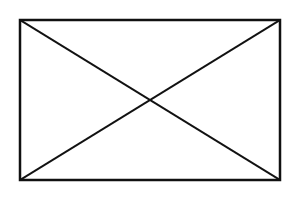
Find the next term in the series: \(2, 6, 12, 20, 30, \ldots\)
Find the next term in the series: \(2, 5, 11, 23, 47, \ldots\)
Find the next letter in the series: \(A, C, F, J, O, \ldots\)
Find the next pair of letters in the series: \(BA, DC, FE, HG, \ldots\)
The total number of squares and rectangles in the following figure is:
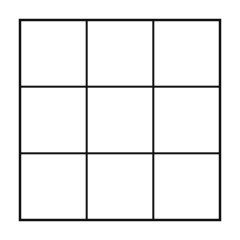
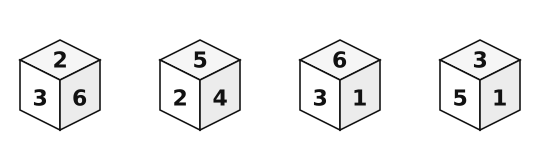
If four different positions of a dice are shown below, what number is opposite to 3?
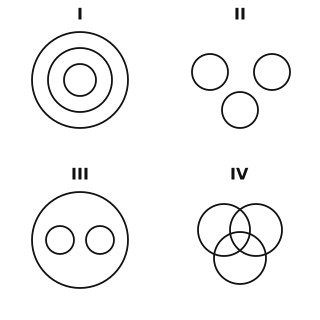
Match LIST-I (Group) with LIST-II (Venn diagram). Choose the correct answer from the options given below:
| LIST-I (Group) | LIST-II (Venn diagram) | |
|---|---|---|
| A. Hospital, Nurse, Patient | I. Three concentric circles | |
| B. Polygons, Quadrilaterals, Rhombus | II. Three disjoint circles | |
| C. Engine, Piston, Wheel | III. Two disjoint circles inside one | |
| D. Father, Son, Brother | IV. Three mutually overlapping circles |
Statement: “Use ABC-brand toothpaste for better dental care.” — an advertisement
Conclusions: (I) People are conscious about their dental care. (II) Other brands of toothpaste are not effective.
Which of the conclusions can be drawn from the statement?
Statement: “Heavy rains cause severe floods in many parts of the country every year.”
Conclusions: (I) Flood is a natural calamity. (II) Heavy rains always cause floods.
Which of the conclusions follow from the statement?
The mirror image of the figure given below is:
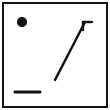
Five problem figures are given below. Which of the following will continue the same pattern as established by the above figures?

The water image of the figure given below is:
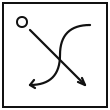
Find the missing number that should replace the question mark in the figure below.
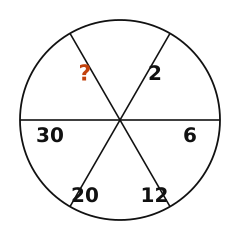
Question: What is the present age of P?
Statement I: P is 5 years older than Q.
Statement II: Q is 25 years old at present.
Question: Among four friends A, B, C and D, who is the tallest?
Statement I: A is taller than B but shorter than D.
Statement II: D is taller than C.
Instructions [60-63]:
The bar chart below shows the total number of students who appeared and qualified at a management entrance examination from five cities. Use the chart to answer the questions that follow.
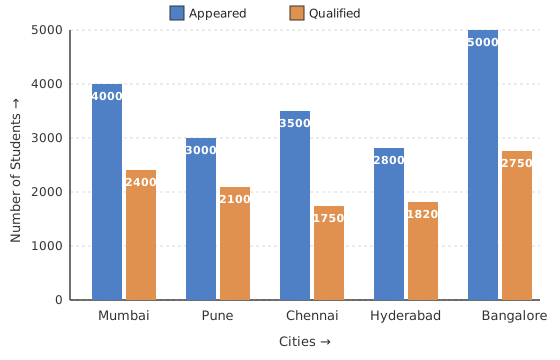
The total number of students who qualified from all five cities together is:
The city with the highest pass percentage is:
The number of students who appeared from Mumbai is what percentage of the number of students who appeared from Bangalore?
The average number of students who qualified from Pune and Hyderabad together is:
Instructions [64-66]:
Five friends — A, B, C, D and E — went together to watch a film. They occupied five adjacent seats numbered 1, 2, 3, 4 and 5 (from left to right), one person per seat. Use the facts below to answer the questions that follow.
- A occupies seat number 3.
- B sits immediately next to A, on the higher-numbered side.
- C occupies seat number 1.
- D does not sit at either end of the row.
Who is seated on seat number 5?
Who is seated between A and E?
How many people are seated between C and E?
Verbal Ability
Choose the word that is most nearly the synonym of: ABUNDANT
Choose the word that is most nearly the synonym of: METICULOUS
Choose the word that is most nearly the synonym of: ENIGMA
Choose the word that is most nearly the synonym of: CANDID
Choose the word that is most nearly the antonym of: TRANSIENT
Choose the word that is most nearly the antonym of: PROHIBIT
Choose the word that is most nearly the antonym of: HUMBLE
Choose the word that is most nearly the antonym of: ABRIDGE
Identify the part of the sentence that contains a grammatical error:
- Each of the boys / (B) have submitted / (C) his assignment / (D) to the teacher.
Identify the part of the sentence that contains a grammatical error:
- She along with her sisters / (B) are coming / (C) to attend / (D) the function tomorrow.
Identify the part of the sentence that contains a grammatical error:
- Neither he / (B) nor his friends / (C) was / (D) present at the function yesterday.
Identify the part of the sentence that contains a grammatical error:
- He is one of the most / (B) intelligent student / (C) I have ever / (D) met in my life.
Choose the option that best completes the sentence:
The committee has _________ a new policy for environmental protection.
Select the word that fits the blank:
He could not _________ the loss of his pet dog.
Pick the option that best fills in the blank:
The new branch of the company will be _________ on the outskirts of the city.
Complete the sentence with the best option:
She is well versed _________ classical music.
Rearrange the following sentences into a logical order:
P. The students cheered loudly as the trophy was raised.
Q. After weeks of preparation, the day of the final match arrived.
R. The captain hugged his team-mates and thanked the coach.
S. With one last decisive goal, the home team won the championship.
Rearrange the following sentences into a logical order:
P. He had to walk back home in the rain.
Q. Ravi missed the last bus by just two minutes.
R. By the time he reached, he was completely drenched.
S. As he stepped out of the station, dark clouds gathered overhead.
Rearrange the following sentences into a logical order:
P. Today, online learning is part of mainstream education.
Q. Internet access made knowledge available to people across the world.
R. Earlier, education was largely confined to physical classrooms.
S. The arrival of digital technology changed this completely.
Choose the meaning of the idiom: “to let the cat out of the bag”
Choose the meaning of the idiom: “to bite the bullet”
Choose the one-word substitute for: A person who studies past human cultures through buried objects and ruins.
Choose the one-word substitute for: A form of government in which power lies with the people, exercised directly or through elected representatives.
Choose the most appropriate word for the blank:
Despite repeated reminders, many citizens still _________ to follow basic traffic rules.
Fill the blank with the best choice from below:
Public-awareness campaigns can play a _________ role in changing this behaviour.
Instructions [92-96]:
Read the following passage carefully and answer the questions that follow.
Container shipping transformed global trade in the second half of the twentieth century. Before standardised steel boxes appeared in the 1950s, loose cargo was packed, unpacked, and re-packed at every port by armies of dockworkers — a slow, expensive, and damage-prone process. The container, by contrast, could be loaded once at the factory, sealed, transferred between ship, rail, and truck without being opened, and unloaded only at its final destination. This single innovation drastically cut handling costs, made shipping schedules more predictable, and allowed manufacturers to source parts and finished goods from almost anywhere in the world. By the early 2000s, more than ninety per cent of non-bulk freight moved in containers, and ports that adapted quickly — such as Singapore and Rotterdam — grew into global trade hubs. Cities that resisted the change, like New York’s old break-bulk piers, lost much of their port traffic to newer container terminals nearby. Containerisation, in short, did not merely make shipping cheaper; it rewired the world’s industrial geography.
According to the passage, what was the central difference between break-bulk shipping and container shipping?
Why, according to the passage, did older ports such as New York’s break-bulk piers lose much of their traffic?
The phrase “rewired the world’s industrial geography” suggests that containerisation:
By the early 2000s, what share of non-bulk freight was being moved in containers?
Which of the following titles best captures the central theme of the passage?
Instructions [97-100]:
Read the following passage carefully and answer the questions that follow.
For centuries, sleep was treated as a passive state — a kind of nightly shutdown of the body and mind. Modern neuroscience has reversed this view. Sleep, researchers now understand, is one of the most active and indispensable periods of brain work. During deep slow-wave sleep, the brain consolidates new memories, moving information from short-term to long-term storage; during rapid-eye-movement (REM) sleep, it integrates emotional experiences and supports creative problem-solving. A growing body of evidence also suggests that the sleeping brain physically clears out metabolic waste — including proteins linked to neurodegenerative disease — through a network of channels called the glymphatic system. Chronic sleep deprivation, therefore, is not merely uncomfortable: it impairs learning, emotional regulation, immune function, and long-term brain health. The eight hours we spend asleep, far from being lost time, are when much of the day’s mental work actually gets finished.
The central idea of the passage is that:
According to the passage, slow-wave sleep is most directly associated with:
What does the passage say about the glymphatic system?
Which of the following is NOT mentioned in the passage as a consequence of chronic sleep deprivation?